
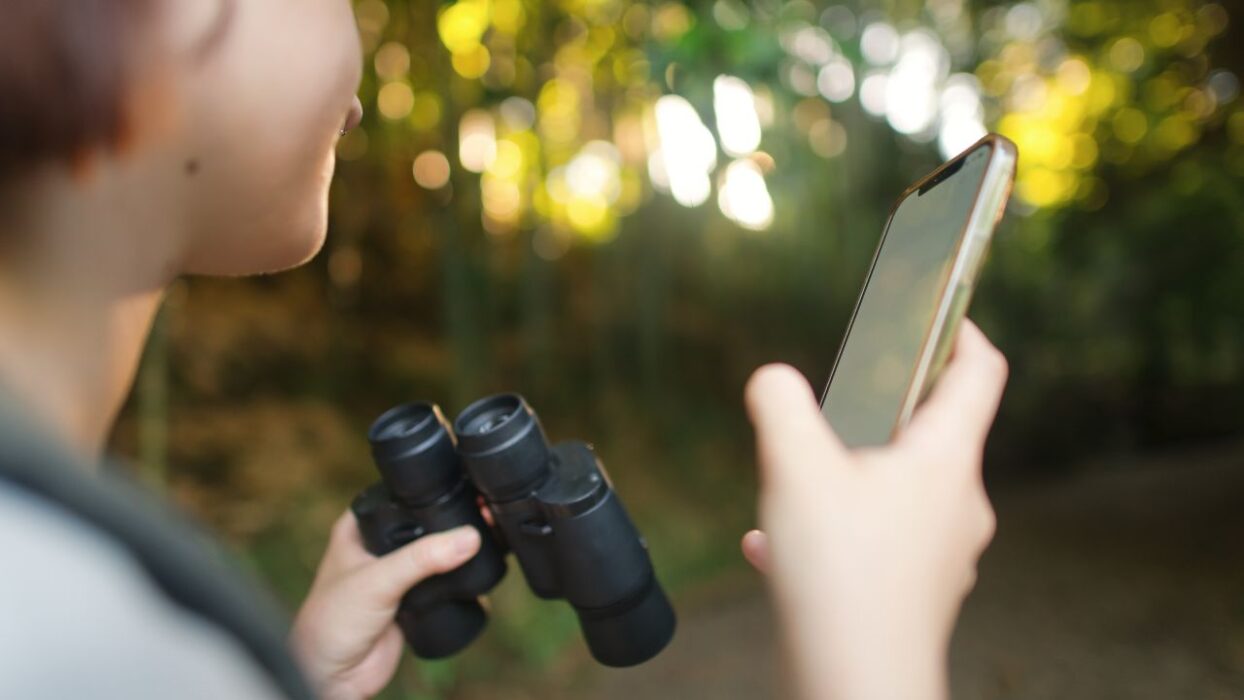
Birdwatching Is Officially Cool, and Science Says We’re Right to Be Obsessed
Ever since I moved away from the city, I started stopping more often to watch a black bird perched on the rocks by a nearby river. Nothing special, really. I would just stop and watch it bask in the sun with its wings spread out. After a few months, I looked it up online to learn what kind of bird it was and found out it was called a Great Cormorant. Without any grand expectations, I started learning everything I could about it. Stopping to watch it every day, knowing a little more about it each time, made me feel good in a way I could not fully explain.
Three years later, I moved even farther away, up a mountain, isolated from almost everything, and the first thing I did was learn the names of the birds that showed up in my garden. Blackbirds, robins, blue tits, they all had names now. Before long, I set up a feeder and watched them come every day. My neighbors told me I should stop feeding them once spring arrived, but they kept coming back to visit anyway, or at least I like to think they did.
In the end, and contrary to my usual style, I became part of a global trend: birdwatching. And it turns out science can explain exactly why.
Everyone you know is suddenly looking up
Birdwatching has quietly become one of the fastest-growing hobbies on the planet, and people are noticing it everywhere, from boutique resorts to bachelor parties. At Ocama, a retreat above Rincón Bay in the Dominican Republic, birding and nature experience partner Halle Jackson told Reader’s Digest he has been amazed by how many guests in their twenties and thirties arrive “already curious and prepared” to spot the area’s bird species, often using apps to identify everything from the endemic Hispaniolan woodpecker to migratory warblers passing through. “Birding has become less of a niche activity and more of a mindful way for travelers to connect with place,” he said.
According to the U.S. Fish & Wildlife Service’s 2022 survey, cited by Reader’s Digest, 37 percent of Americans ages 16 and older, around 96 million people, qualified as birders, or birdwatchers, whether they were identifying species from their own backyard or traveling at least a mile to do it. At the time, the hobby still skewed older, with an average birder age of 49 and 44 percent of birders over 55. But participation among younger age groups was already sitting between 30 and 36 percent, a number that has only climbed since.
The numbers behind the binoculars
In Britain, the shift has been dramatic enough to make headlines on its own. The RSPB commissioned a study from the analytics firm Fifty5Blue, surveying over 24,000 people, and found that regular birdwatching had grown 47 percent across all age groups since 2018, according to The Guardian. Among Gen Z specifically, that growth hit 1,088 percent. The BBC reported that the number of 16 to 29-year-olds who regularly watch birds in Britain rose from an estimated 61,000 in 2018 to 724,000 today, making birdwatching the second fastest growing hobby for that generation, just behind jewelry making. The RSPB now estimates there are over four million birdwatchers in the country, up from 2.7 million eight years ago.
The same pattern is showing up in the United States. The hashtags #birdwatching and #birding have racked up over a billion views on TikTok, according to 13News Now, and Cornell University’s Great Backyard Bird Count saw participation jump 44 percent in 2023. Bird-tracking apps like Birda have reported monthly growth rates of around 30 percent.
Why Gen Z is trading screens for binoculars
Ask the people actually doing it, and they all share the same argument: this is about getting away from a screen, not finding a new one to stare at. Poppy Rummery, a visitor manager at RSPB Bempton Cliffs, told the BBC that younger visitors “really want to get out into nature, learn to identify birds, improve their physical and mental health.” The RSPB has since launched a scheme offering free admission to its reserves for anyone between 16 and 24.
Jess Painter, 24, a member of the RSPB’s Youth Council, agreed. “When I’m watching birds, I’m not thinking about anything else – it’s a moment of peace and a way to reconnect with nature and with myself,” she told the BBC. Fortune described the broader pattern as part of an “analog movement,” a phrase The Week picked up to describe young people gravitating toward hobbies, sometimes nicknamed “grandma hobbies,” that pull them out of their phones rather than further in. Isaiah Scott, a 22-year-old who has logged sightings of around 800 species, explained it playfully to Fortune, in comments cited by The Week: “It feels like a video game, but in real life.”
Quinn Dudley, a 27-year-old biologist who spent a recent vacation birding through Guatemala with his brother, told Reader’s Digest there is a stigma that needs correcting. “There’s a stigma that birdwatching is an old-person hobby—people retired with nothing better to do,” he said. “But it’s actually very thoughtful and intentional for people of all ages who want to be more observant and immersed in the natural world around them.”
Millennials would rather watch from the window
If Gen Z is heading out to reserves and national parks, millennials seem to be meeting the birds halfway, often without leaving the yard. On Reddit’s r/Millennials community, a 35-year-old user named Pnw_moose described how a pandemic habit of feeding peanuts to jays on a windowsill grew into something more serious, now getting into binoculars and eBird, crediting the documentary “Listers” for pulling them in further.
That pattern was already visible back in 2020, when stay-at-home orders sent people looking for something to watch besides the news. The Orange County Register reported a surge in deliveries from Wild Birds Unlimited stores as customers stocked up on feed rather than going without their birds. “Birds have a calming effect,” Diann Tomb, an assistant manager at the chain’s Mission Viejo location, said at the time. “Forget watching television, which only causes more stress. Watch the birds instead.” Avid birder George Nothhelfer, unable to travel for his usual excursions, told the paper he simply started walking his own neighborhood instead, noting that spring migration was still happening right outside his door.
What the science actually says
The benefits are not just in our heads. A study published in the Journal of Neuroscience found distinct structural and functional differences in the brain regions tied to memory, attention, and visual processing among bird identification experts, according to Reader’s Digest. Separate research in the Journal of Environmental Psychology found that college students who went birdwatching reported improved mood and psychological well-being compared with both a nature-walk group and a control group who did neither.
The numbers get stranger from there. A study published in Scientific Reports found that simply hearing birds chirp was associated with an improved mental state for up to eight hours afterward, 13News Now reported. Research published in Ecological Economics found that increasing the number of birds in someone’s surroundings boosted life satisfaction by roughly the same amount as a salary increase of the same percentage. And a Canadian study cited by Science Alert and referenced in The Week found that brain regions linked to attention and perception appeared denser in scans of experienced birdwatchers than in those of newcomers, suggesting the hobby may help guard against cognitive decline later in life.
Amir Khan, a doctor, broadcaster, and president of the RSPB, offered the simplest explanation of all to the BBC. “Hearing birdsong, especially during the dawn chorus when they’re at their loudest and most beautiful, can produce more serotonin and make us feel good,” he said.
A hobby that asks you to slow down on purpose
None of this fully explains why I stopped to watch a Cormorant on a riverbank, or why I kept refilling a feeder my neighbors thought I should abandon. But maybe that is exactly the point. Psychology professor Jaime Kurtz of James Madison University told The Week that hobbies in general are “really important,” and that we “don’t prioritize them enough.” These activities reduce anxiety and stress, she said, and offer a sense of accomplishment, especially when they involve finishing something genuinely challenging.
There is no app notification when a blue tit lands on the feeder. Nor is there an algorithm deciding whether I should care. It just…happens. I notice it, and for a few minutes, that is the entire transaction. Millions of people, scattered across very different generations and very different reasons for picking up a pair of binoculars, seem to have coincided on the same quiet discovery at roughly the same time.