
Op-Ed: Stanley Cups, Barbies and Ofrenda Kits: What America Gets Right and Wrong About Día de los Muertos
One defining trait of the United States as a system is its tendency to commodify almost everything. Life revolves around what we can consume, from ideals to rituals. You only have to look at a store window this time of year, where pumpkins now sit beside cempasúchil and papel picado, sometimes in the windows of companies whose money helps elect politicians who vilify the very people these traditions come from.
But can’t one thing coexist with the other? That is the crux of the matter.
A Ritual for the Dead, Sold by the Aisle
A few weeks ago, Stanley 1913 launched its Day of the Dead cups, decorated with papel picado and cempasúchil and, for many, almost too pretty to drink from. They join a long list. In 2019, Mattel launched a Day of the Dead Barbie, a $75 doll in a black mermaid gown covered in monarch butterflies and marigolds. Last year, Sehila Mota Casper, director of Latinos in Heritage Conservation, told the Associated Press that chains like Target and Walmart were selling kits to build your own ofrenda, as companies tried to profit from Día de los Muertos the way they did with Cinco de Mayo.
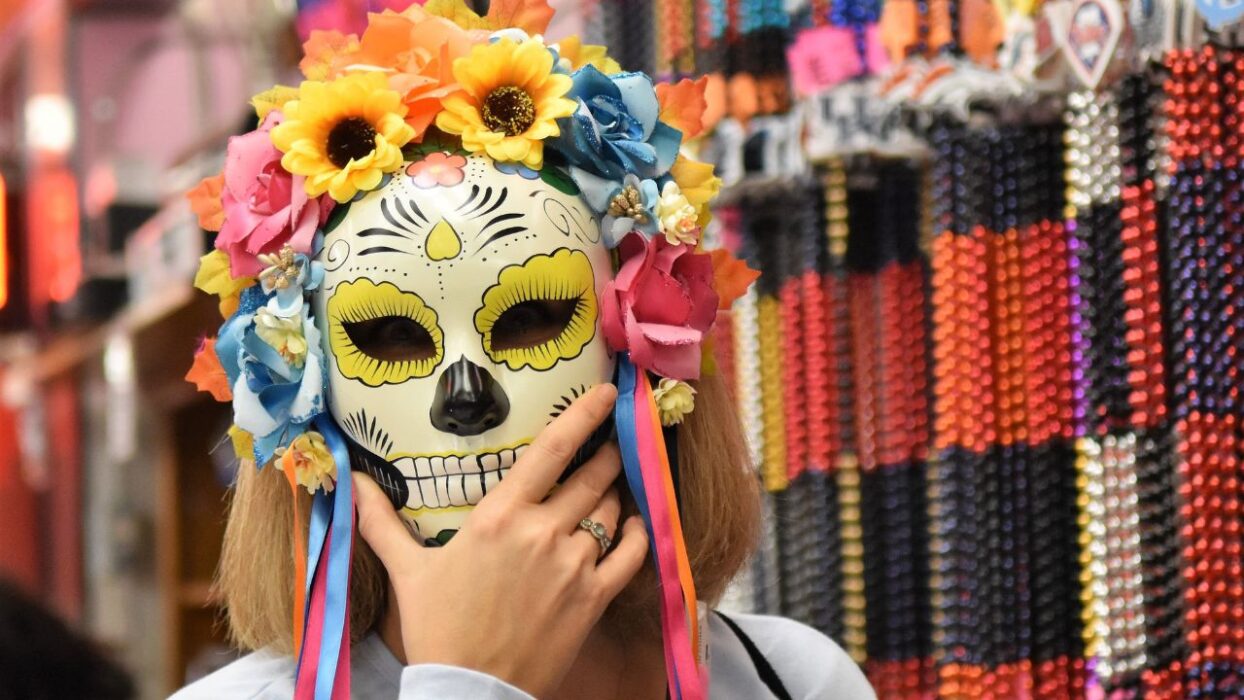
Little by little, commercialization blurs the line between the calaveras of a Mexican ritual and the skeletons of Halloween, a pastiche worth pausing on. Juan Carlos Aguirre, executive director of Mano a Mano, a New York nonprofit dedicated to Mexican culture, told The New York Times that catrina makeup in the U.S. often includes a spiderweb on the forehead. No need to remind you the web is a Halloween symbol of abandoned graves, which has nothing to do with a holiday built on honoring loved ones who passed.
In the end, it makes sense for any savvy entrepreneur to court a community whose economic output reached $4.4 trillion in 2024, enough to rank fourth in the world if U.S. Latinos were their own country, according to the Latino GDP Project from UCLA and California Lutheran University. It just doesn’t seem to matter that the same community is being targeted by deportations and arrests.
“Obviously it’s cultural appropriation, but how can I put it? It’s what this country loves to do. Everything is about publicity,” Mariluz González, co-host of a Los Angeles radio show, told The New York Times. “Is our culture benefiting economically from it? Is this government doing anything for us? With the raids and all that, what we should be happy about is a doll?”
The Tradition Didn’t Come in a Shopping Cart
Día de los Muertos is estimated to be about 3,000 years old, rooted in Aztec and other Mesoamerican traditions that treated death as a natural part of life. With La Conquista, Spanish colonizers shifted it onto the Catholic calendar, folding it into All Saints’ Day and All Souls’ Day on Nov. 1 and 2, and from that mix of Indigenous and Catholic practice came the holiday families still keep. Mexican immigrants have brought those rituals to the U.S. since at least the 1890s, mostly as quiet, religious family observances at church and at cemeteries.
However, the version most Americans recognize was a political manifesto. In the early 1970s, Chicano artists sought the Indigenous roots that a country obsessed with assimilation had taught them to hide. And they brought Día de los Muertos into the streets through processions, public altars, and art workshops. In East Los Angeles, Self Help Graphics & Art led one of the first of these celebrations in 1973, with a parade that ended at a cemetery altar honoring people killed by gang violence, the Smithsonian notes.
“For Chicano artists in the 1970s, celebrating an indigenous Mexican ritual in an Anglo-dominant country was an act of political resistance as well as an act of cultural pride,” said Regina Marchi, a Rutgers University professor and author of Day of the Dead in the USA.
Even the holiday’s most marketable image was born of critique. La Catrina, the elegant skeleton whose face now appears on goods in stores across the country, was the Mexican printmaker José Guadalupe Posada’s satire of rich women in pre-Revolutionary Mexico who dressed as if they lived in Paris, according to the Smithsonian. Posada also drew politicians and elites as skeletons, a reminder that under the hats and feathers, everyone has the same bones.
From a Disney Trademark Fight to a $75 Barbie
Furthermore, the best example of the everything-is-for-profit American mentality came from Disney.
In 2013, the company tried to trademark the phrase “Día de los Muertos,” and the backlash from Latinos was so strong that it withdrew its application. What did Disney do instead? It released Coco in 2017. Cesáreo Moreno, chief curator at the National Museum of Mexican Art in Chicago, told the Associated Press the film opened the tradition to people outside the Mexican American community and made it far more marketable.
“It breaks my heart when I see it so commercialized. It’s U.S. capitalism,” Laura Larque, a history professor at Santa Rosa Junior College, told La Prensa Sonoma in 2019. “When they take the cultural expressions of peoples and turn them into something they can sell.”
Not every Latino sees it that way. When the Día de los Muertos Barbie launched, Patty Rodríguez, founder of the bilingual children’s publisher Lil’ Libros, told The New York Times she would buy one because the doll gave Mexican and Mexican American identity a kind of visibility the community has long fought for. In this vein, Mathew Sandoval, a Mexican American scholar of culture and performance, has argued that it’s time to acknowledge how much Halloween and Día de los Muertos are already mixing, even in Mexico. “Día de los Muertos may live eternally,” he wrote in The Conversation, “but it’ll be thanks to the vampire bite of Halloween.”
The Beauty Inbetween
And still, for Latinos, sharing our traditions has always been a cause for celebration. What could be more beautiful than teaching millions of people to celebrate something as sad as death with vibrant colors? Much of what makes us such a strong community is our ability to welcome others, invite them in, and share what we are proud of.
Marchi has asked hundreds of people why the holiday has spread so widely in the U.S., and she said the answer is usually the same. “Deep down, many people in the U.S. are drawn to the idea of having an annual event to collectively honor deceased loved ones,” she said. “It can be grounding, since thinking about the inevitability of death makes people appreciate life more.”
And she’s right. Celebrations now take place in all 50 states.
In a country that has given us so few public spaces to grieve, a Mexican ritual has taught people far beyond the community to build altars for their dead. Some will buy a cup or build an altar from a kit, while families who have kept the tradition for generations will set out mole, photographs, and the music their loved ones liked. Its strength, said Déborah Holtz, editor of the book 02.11. Día de muertos, in remarks reported by El Pregonero, is that “it is a living tradition.”
The least we can ask of those who profit from La Catrina is to remember what Posada drew her to say. We all end up as bones, and the people who gave this country such a beautiful way of remembering its dead deserve to be treated as fully human while they are alive.