
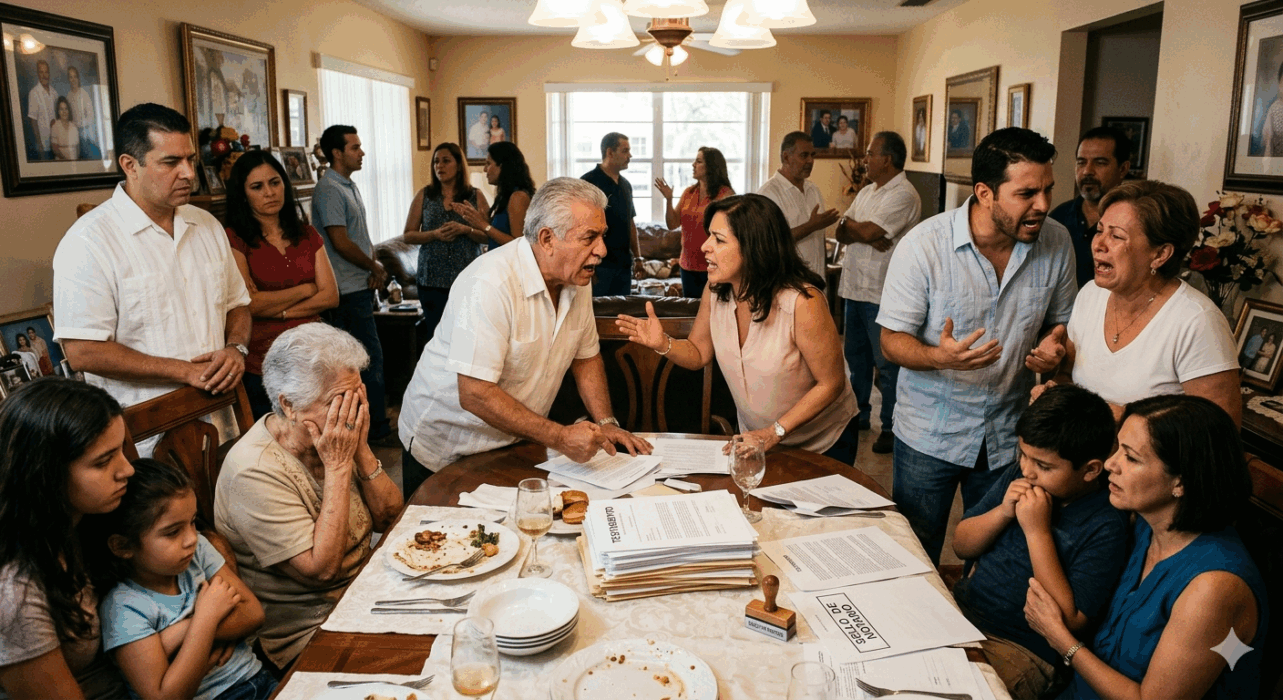
Los Terrenos: The Latino Family Beef That Never Misses a Holiday
There is a tío in every Latino family who starts thinking about property lines before anyone has finished crying at a funeral. He shows up to the velorio in a black suit, hugs the right people, and then pulls a cousin aside to ask who has the deed. By the time the casket closes, half the family already knows where this is going. It is going to los terrenos.
On Reddit, someone titled a post “Listos para la pelea anual por el terreno de la abuela?” asking other families whether their tíos also fought over grandma’s land every year. “This year, I’m not taking part in the family celebrations,” she wrote, only half joking. Dozens of replies followed, each one describing a version of the same fight with a different cast of tíos.
Why Every Family Reunion Turns Into a Fight Over “Los Terrenos”
Scroll through Reddit’s r/AskMexico and r/preguntaleareddit, and the stories start to rhyme. One commenter described a grandfather who divided a plot into six pieces for six siblings. He did so with strict conditions about who could inherit and sell. Still, when his mother died before his grandfather and the land passed to him instead, his uncles changed the locks on his own house while he was at work and never told him why. The uncles who turned on him over that eventually turned on each other, too. And began fighting over which one of their six plots faced the street and could host paying tenants.
como ha sido “la pelea por los terrenos” o discusiones de herencia tras la muerte de un familiar en tu círculo de familia o conocidos?
by u/mambadagger in preguntaleareddit
Another commenter remembered aunts ransacking her late grandmother’s room looking for anything of value. They ended up fighting over a stove that was fifty years old. “People lose all sense of shame over money,” one commenter wrote, and the replies under nearly every story agreed.
Someone asked, half-sincerely, whether this was really as common as the memes made it sound, or just a joke that resurfaces every holiday season. “It happens more often than you think,” another replied. One commenter said it had been more than twenty years since their mother and her siblings had last spoken or gathered. All thanks to a rift that started over a single piece of land and never healed. A video titled “¡Todo por los terrenos! Familia pelea por la herencia mientras van al panteón,” about a family fighting over an inheritance on the way to the cemetery, racked up more than 800 upvotes and over a hundred comments on Reddit’s r/mexico.
The Real Reason Latino Families Never Write a Will
According to an analysis from Panamericana Televisión, the most common cause of these fights is not greed. It is paperwork, or the lack of it. Older generations often pass down property through verbal agreements instead of a formal will. They do so assuming everyone will simply share it fairly once they are gone. Without a clear legal division, every sibling and cousin is left to decide for themselves what fairness looks like.
The problem gets more complicated when the land sits in one country, and the family lives in another. Decades of remittances often go toward building or expanding a house back home, and once the parents are gone, the siblings who paid for the roof and those who paid for nothing both feel entitled to the same square footage. Foreign deeds, unfamiliar inheritance laws, and a home country thousands of miles away make the dispute almost impossible to settle quickly, which is exactly why it tends to drag on for years, sometimes for generations.
Losing “Los Terrenos” Used to Mean Losing Everything
The jokes about tíos and locked doors are funny because they are recognizable, but underneath the meme sits a history that is not funny at all. A 2013 report from the Inter-American Institute for Cooperation on Agriculture, the United Nations’ Food and Agriculture Organization and the Economic Commission for Latin America and the Caribbean found that land in Mexico, Central America and the Andean countries tends to fragment generation after generation through exactly this pattern, with sales and inheritance splitting big plots into smaller ones, while land in the Southern Cone tends to concentrate in fewer hands instead. The same report found that only about half of small farmers across the region hold a secure, formally registered title to the land they live on, because the legal process of titling property is too expensive and complicated for most families to finish.
For Mexican American families specifically, the fear of losing land is not unfounded. According to a historical account published by San José State University’s Martin Luther King Jr. Library, the 1848 Treaty of Guadalupe Hidalgo promised that the property of Californio landowners would be inviolably respected after the Mexican-American War. In practice, vaguely drawn land grant maps made it nearly impossible for many families to prove their claims in U.S. courts, and the Board of Land Commissioners created by the Land Act of 1851 dragged the process out for an average of 17 years, a length that forced many Mexican Californios to sell off land just to pay lawyers and taxes. Others lost land outright to squatters. The Peralta family of San José and the East Bay went from 49,000 acres to roughly 700.
The Joke Is Real Because the Fear Is Real
None of this makes the fight over the abuela’s stove any less ridiculous, or any less likely to happen again next Christmas. But the reason the joke resonates so hard in so many Latino households is that it sits atop something real. Families who have had land taken from them through small print, slow courts, and outright theft do not entirely trust that it will not happen again, even from each other. The tío who changes the locks the week of the funeral is not really fighting about a house. He is making sure that this time, whatever happens, it will not be a stranger’s signature on the deed.
That does not mean anyone has to enjoy sitting through it. It just means that the next time a cousin starts arguing about square footage before the flowers wilt, it might be worth remembering that the fight is older than the funeral, the grudge, and, ultimately, older than all of them.