
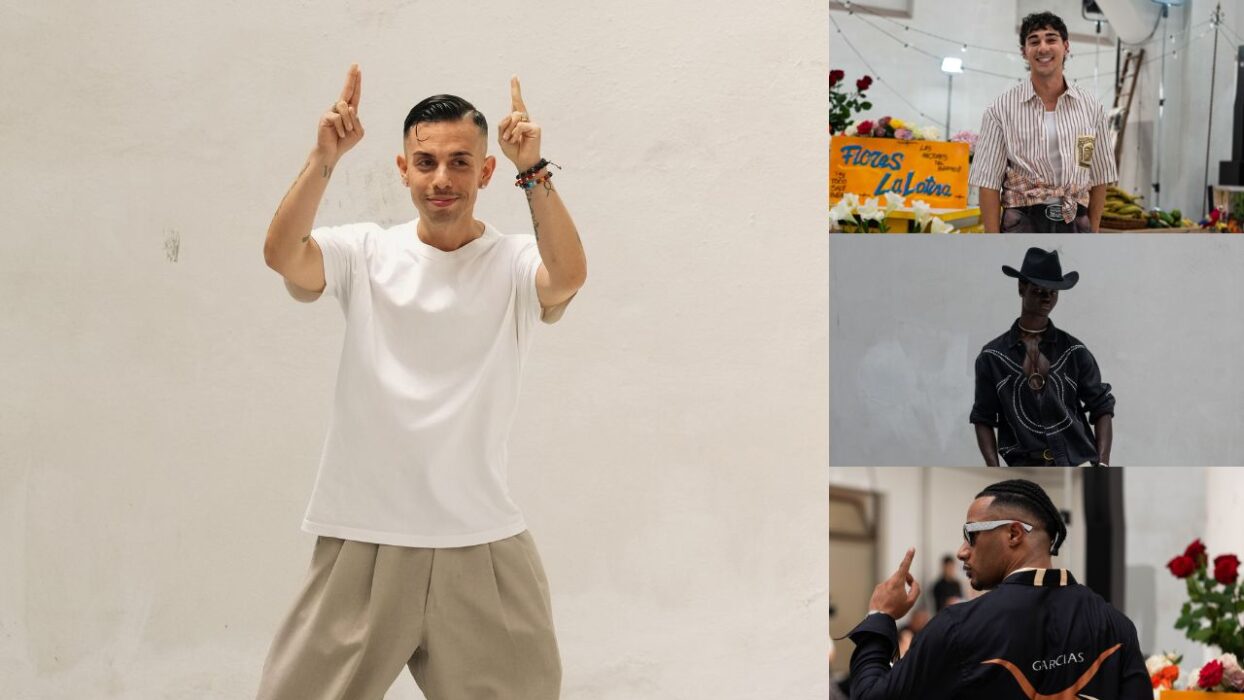
Meet Nicolás García, The Colombian Designer Who Just Made History at Milan Fashion Week
Two years ago, Nicolás Martín García was standing at a Karol G concert when he started to cry. He was watching Karol G’s father watch his daughter perform, and something about that image, a father standing there, overwhelmed by pride, undid him completely. “There is nothing better,” García says, “than a father or a mother seeing how big their child has grown.”
He was thinking about his own mother, who had enrolled him in fashion school in Rome roughly fifteen years earlier when she didn’t know where the money would come from, who had simply told him, “I’ll figure it out.”
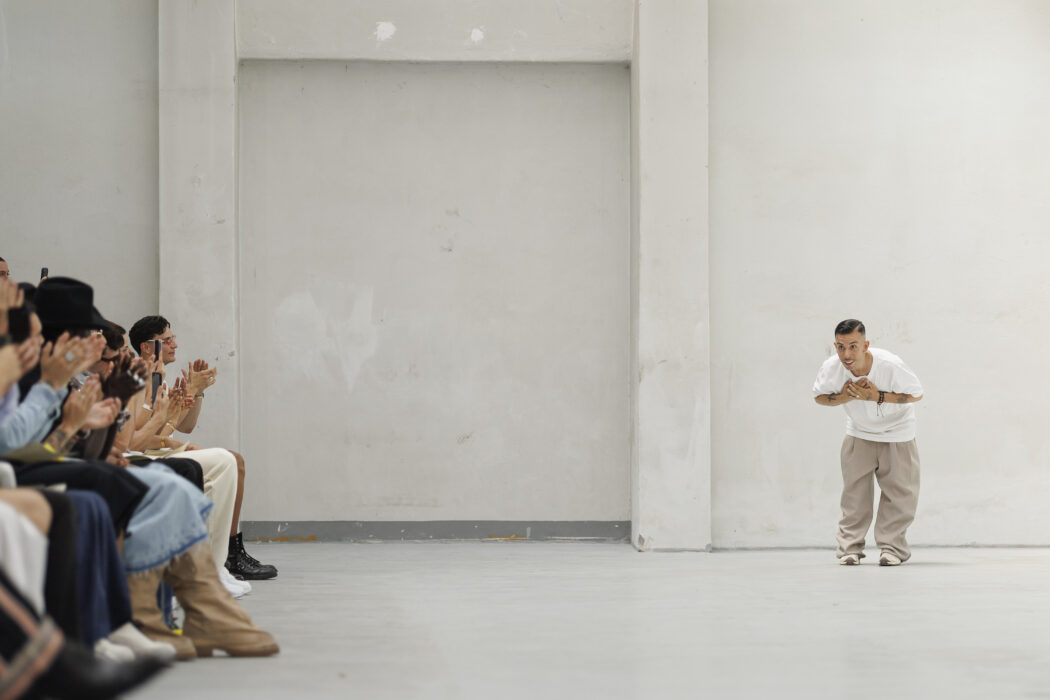
On June 20, 2026, his brand GARCIAS presented its Spring/Summer collection, “Latin Dreamers,” on the official Milan Fashion Week calendar of Camera Nazionale della Moda Italiana, becoming the first Colombian fashion brand in history to do so. During the event, Boza walked the runway, and La Guru performed live. Ryan Castro, Chris Olave, CKay, and Danielle Ciniegas, among others, were in the room. García conceived the show as a full recreation of a Latin American neighborhood, with live music, dance, and the phrase that underpins the entire project: “Si lo crees, lo creas.” If you believe it, you create it.
The Colombian Boy Who Grew Up Italian
Nicolás Martín García was born in Bogotá, his family split between Bucaramanga and Medellín, and arrived in Italy at age five in 1996. He has been there for thirty years since, twenty in Rome and fifteen in Milan, and he is candid about what that long arc did to his sense of himself. “For a long time, I was much more connected to my Italian side than to my Latino side,” he says. “I reconnected with my Latino side much later, already in adulthood.”
However, he did not grow up dreaming of fashion. His passion was criminology. He loved CSI, the analytical logic of assembling a case from scattered evidence, and he still considers it a hobby of sorts. Eventually, he drifted at nineteen, uncertain of direction, and found his way through design. He enrolled at the Accademia di Costume e di Moda in Rome, the same school that produced Alessandro Michele, now creative director of Valentino, formerly of Gucci. Nicolás and Michele even have had professors in common.
Rome, Nicolás says, gave him something Milan could not have offered at that age. He learned beauty at the epicenter of the concept. “Before fashion, I learned what art is, what culture is, what beauty is,” he says. “And that is reflected in my work and in my mentality.” His sense of beauty, he notes, is unabashedly maximal. It comes from years of standing in museums, from the weight of Roman columns, from a decorative tradition that highlights excess as its own form of beauty.
At twenty-three, with his degree finished, he had his first job interview with Domenico Dolce. It was not through HR or a design director. He sat across Domenico Dolce, co-founder of one of the defining houses of Italian fashion. Nicolás describes himself then in the Colombian way: un pollito. A little chicken. “I remember it was a Friday and Domenico said: ‘You start on Wednesday.’” He began in menswear at Dolce & Gabbana, working in leather and eventually embroideries, then moved to Roberto Cavalli, where he rose to lead the celebrity department and dressed Karol G, Madonna, and Jennifer López, among many others.
Then, Everything Changed in La Comuna 13
GARCIAS was born out of an identity crisis. In 2022, García was going through what he describes as depression, and he traveled to Colombia, to Medellín, a city he had never known. He ended up in La Comuna 13.
La Comuna 13 was once one of the most dangerous neighborhoods in a city considered among the most dangerous in the world. Today it is a neighborhood of restaurants, murals, dancers, and an almost disorienting explosion of life. Nicolás stood there and felt something shift. “I looked around and said: I would love to do a fashion show here. Like Jacquemus does in the south of France, in Marseille. But here, in La Comuna 13.”
At the time, he did not have a brand, much less a runway or a collection. The thought was, by his own account, completely absurd. But the profiler’s mind activated: he had the years of experience, the contacts, the trajectory. The least he could do was try.
He then traveled to Cartagena. He went to the top floor of his hotel. It was raining. “I spoke to God, I cried, and said: if this is what you want for me, I’m going for it. But you have to help me.” When he returned, he wrote a comprehensive five-year development plan for the brand that included strategy, identity, client, community, and aesthetic, mapped in full. He believes that document is the reason GARCIAS launched as solidly as it did. “From the beginning, I had everything very clear. How the brand would be. And that helped it start.”
Nicolás García, The Colombian Designer Who Translates Culture Into Something the World Can Wear
Nicolás García knows exactly what GARCIAS is and who it is for. “I am Colombia-born, Italy-raised, and I have always had a link with American culture,” he says. “I listened to Grupo Niche alongside Whitney Houston, Celia Cruz alongside Mariah Carey. That is what I am.” That tapestry is evident in his brand. Colombian cultural references built through Italian craftsmanship, for a community he describes as Latino, Afro-Latino, and Black. “Everything I have achieved in such a short time, sometimes I can’t even register it myself. I have achieved it thanks to the community of people around me.”
He speaks with respect for Willy Chavarría, who has effectively placed the word “Latino” in the fashion conversation, and then explains what he is doing differently. Chavarría’s cultural reference is Chicano, Mexican-American, Los Angeles. García’s is something else. “Latino for me is the arepa, the aguardiente, the reggaeton. There needs to be all of that, and there is room for everyone, but I want to tell that version of what it means to be Latino.”
And he is doing it, he adds, right at the center of it all.
Milan is not Paris: it is a closed city, historically protective of its own traditions, with little patience for the unfamiliar. That was his fear going in. “I kept asking myself: will they understand this in Milan?”
They did. In his words, his collection was welcomed as a celebration of a culture more than a fashion show. That was the evidence of a perfect choice. “Being Latino can’t be explained,” he says. “It’s something you feel.” The Spring/Summer 2027 collection paired Colombian references with tailored silhouettes and handcrafted Italian textures. A sombrero vueltiao became a bucket hat. A poncho became a knitwear coat. This is García’s philosophy in a nutshell: folkloric elements must be transformed to travel. “You don’t simply take an original poncho and put it on the runway. You take it and work it into something another audience can understand and use.”
He sees Latino designers, as a whole, looking too much outward to international references and not enough inward to the wealth that exists in Latin America. His position outside the continent is, he believes, what lets him see it clearly. “I go and look at what is outside of me, which is Latin America. And the deeper I go, the more I want to bring out.”
On the First Colombian Brand to Walk the Official Milan Calendar
Nicolás is now thirty-five, three years into a brand that has already made history, resting in Mallorca after six months of preparation for the show that just happened, and planning the next one for January in Milan. The next collection will turn toward the Andes, toward what being Latino means in cold, in altitude, in the cultures of highland Colombia—the perfect translation of what winter means. And yes, there will be ruanas.
He models the broader context of what he is building on Jacquemus: not the aesthetic, but the method, how a designer constructs a universe from personal history, from a mother, a landscape, from a story that he writes as he goes.
“What I want is to create a universe for GARCIAS where people see it as more than a brand, as a movement, as a cultural thing.” And Nicolás García is patient about it. He knows three years is not long, even when it feels like it. “There are processes that take time,” he says, “and I simply have to enjoy it and wait for the moment when things start exploding on their own, without rushing to grow so fast.”
His mother is his greatest support. She has been since the beginning, since she told him she would figure out how to pay for fashion school. He does not describe a single milestone without her somewhere in the frame. Two years ago, watching a father cry with pride at a Karol G concert, it was her he was thinking about. Whatever comes next for GARCIAS, that is the investment he is still honoring.