
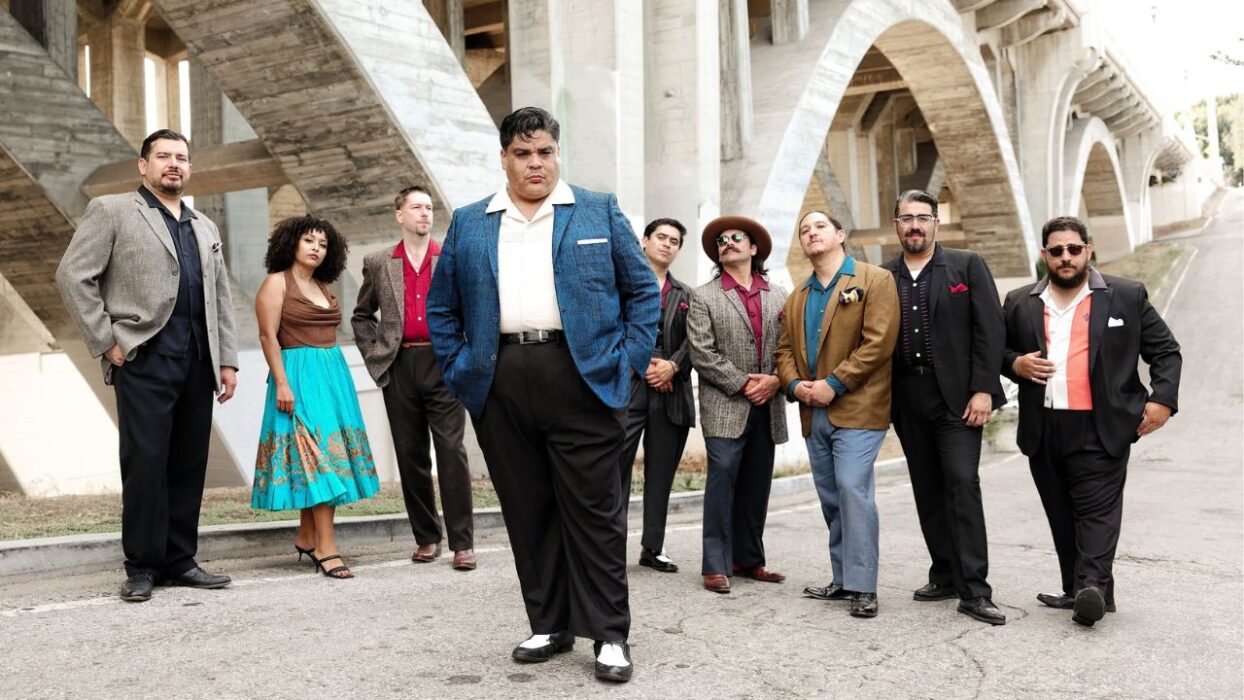
Meet Thee Sinseers, the East L.A. Band Bringing Chicano Soul Home
Around 300,000 new songs are released on streaming platforms every Friday. Most of them are built to be scrolled past by the following week. But amid the noise, a rare jewel is always worth stopping for and listening to closely. Thee Sinseers are one of them.
The nine-piece East L.A. soul group, led by multi-instrumentalist and songwriter Joseph Quiñones, doesn’t make music built for the scroll. They make music for you to keep. The kind you’d want printed and held onto. For Quiñones, there’s no better metaphor. It’s literally how he describes the band’s new songs: as a photo album.
“That’s why Love Stories is kinda like a photo album kind of a concept. Because who still has photo albums?” he said. “One day our pictures are gonna be on the web, and we can just look at that. It’s not gonna be as nice as opening up a book and seeing the history. So we’re trying to bring some of that back. And just giving everybody a moment to stop and appreciate the moment.”
From Marching Band to East L.A. Ska, to Chicano Soul, the History of Thee Sinseers
Thee Sinseers started out as kids who met in marching band.
“We all kind of met each other throughout high school, middle school marching band, jazz band,” Quiñones said. “We got into the Los Angeles ska punk scene in the early 2000s, going on to the 2010s. And we started traveling. We’d been in different bands at a certain point with other people. Our band right now is an amalgamation of a couple of different bands from those years. So it’s kind of like a community of the same musicians.” The early influences were local, including La Resistencia and South Central Skankers out of L.A. And the roots Jamaican ska of the Skatalites, Prince Buster, and Byron Lee & the Dragonaires.
Soul found them almost by accident, through research.
“The music kind of leads you. At a certain point you want to get into what your influences were inspired by. So you dig deeper and deeper, and I think that’s what happened with us,” Quiñones said. “Before we heard of The Delfonics, we heard of Alton Ellis.” Many Jamaican artists, he explained, spent the 1960s, ’70s and ’80s covering American R&B, “so being exposed to these great songs that we thought were originally written in Jamaica, and finding out that they were created in Detroit, Motown, or the Chicano soul, Los Angeles sound in the ’60s,” sent the band digging into their own backyard.
“It was coincidentally the type of music that we all grew up on and were exposed to throughout our childhood and throughout our family gatherings, because our parents listened to soul and doo-wop. Before they called it soul, these were Chicano soul. It was just soul.”
That lineage is the whole premise of the band, formed in East L.A. in 2019 and now made up of Quiñones alongside Eric Johnson on tenor sax, Steve Surman on bari sax, Joseluis Jimenez on trombone, Christopher Manjarrez on bass, Francisco Flores and Bryan Ponce on guitar, Luis Carpio on drums, and Adriana Flores on vocals. They’re part of the Colemine Records family, which released their early singles “It Was Only a Dream” and “I Don’t Mind” in 2019 and their debut LP, “Sinseerly Yours,” in March 2024. “It Was Only a Dream” later turned up in the film “Self Reliance” and on “Riverdale.”
Their Tiny Desk performance was filmed not in Washington, D.C., but at Floreria Primavera, guitarist Francisco Flores’ family flower shop on Whittier Boulevard, vines and recuerdos framing the band.
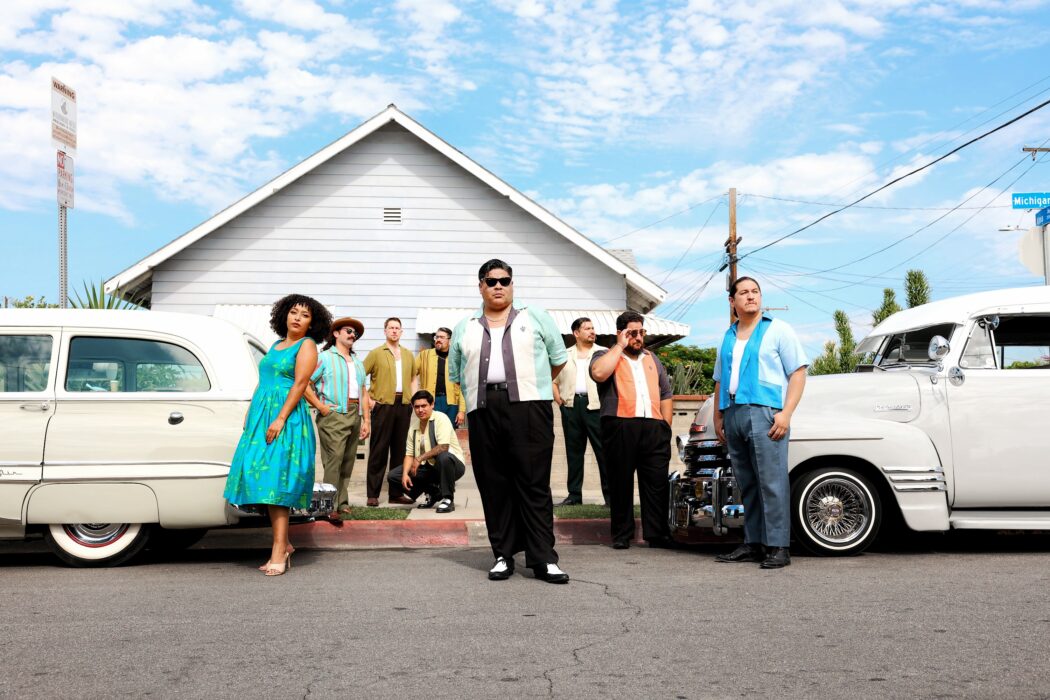
For Thee Sinseers, The Recipe Is Truth, Not Trends
Ask Quiñones what actually makes a good song, and he doesn’t talk about hooks or algorithms.
“Truth, honestly. I think that’s the biggest thing. People can tell when you’re singing about something real, and I think that’s what they connect to with our music; they feel the human quality of it,” he said. “Especially nowadays when everything’s created in AI, people are really, really aching and yearning for that human connection more.”
It’s why a run of shows on the East Coast, a part of the country the band wasn’t sure would care about their sound, ended up meaning the most. “It was emotional, because we went to New York, on the East Coast, which for Los Angeles is always the opposite, the other side of the world to us sometimes,” Quiñones said. “We weren’t sure, but we went over there, and people were asking for them, and they sang every word of the new songs that were out. There was a passion and a feeling behind it when they were singing it, kind of like they were being heard. I think that’s the best thing about this record, the music, and the responses we’ve been getting, is that people feel so connected to it. They feel seen and heard.”
A Sound Built on the Road
Years of touring reshaped what the music actually sounds like. “I like to think that the sound and the instrumentation are very much influenced by the bands we’ve come across traveling, the sounds we’ve heard in New York from other bands, different instruments,” Quiñones said. “Like the 12-string guitar, certain elements that are new in this record, new for us, are definitely stuff we got exposed to through other bands. We traveled with an artist, Benny Trochen, from the Daptone family, who played the 12-string guitar, and it was just a nice sound. It took you back to another layer of nostalgic music. So we adapted that a little bit, inspired by so many things, bands, foods, stuff like that.”
The songwriting, though, came from the opposite of the road.
“The concept of the lyrics and the creativity of the lyrics came in after the tour, when there are no shows, and it’s kind of, you’re in a little bit of a depression, because you come from this excitement into being home and nothing to do,” he said. “So it’s kind of a balance of both.”
Not everyone in the band learned the music the same way, and Quiñones believes that’s part of the magic. “Some of us went on to college, to study music professionally and become teachers, special education teachers, all sorts of different types of jobs. I’ve been touring since I was 16 years old, so I’ve been on the road and in the studio consistently since then, in a flow motion. But some of our horn players are still instructors; they give private lessons. So there’s a balance of people who know what they’re talking about, and a balance of people who don’t,” he said. “But you feel it, so that’s another way of knowing what you’re talking about. Sometimes the most creative and expressive players are the ones who are limited in that knowledge, because they’re reaching for something more than using the basic curriculum.”
We Don’t Have Fans. We Have Friends.
For a band whose entire sound is built towards the live experience, the plan going forward is simple: play more shows, and let more people in.
“We’re just so happy to be able to play music and have the opportunity to be exposed to everybody. We can’t wait to meet everybody,” Quiñones said. He added they’ve always said, “We don’t have fans; we have lots of friends. We love extending that invitation for everybody to come and have a good celebration of life and music.”
That invitation has dates attached. Thee Sinseers kick off their album release run in Austin on October 16, play a hometown show at Los Angeles’ Wiltern on October 17, and head to Mexico City for Corona Capital on November 20, a homecoming of a different kind for a band whose sound has never stopped looking south.