
Science Said The Perfect Penalty Is Impossible. Matías Fernández Said ‘Watch This’
The penalty kick is football’s cruelest moment. Twelve yards from the goal line, a single player faces a goalkeeper, and the entire tournament lives or dies in that fraction of a second when boot meets ball. Those seconds are so crucial that people have been searching for the perfect penalty for as long as penalties have existed. Coaches film them, players practice them obsessively. Analysts break them down frame by frame. And yet, somehow, even the greatest takers in history have missed at least once. So the question persists: Does the perfect penalty exist? Or is it a myth we tell ourselves?
Stephen Hawking, one of the greatest minds in physics, spent time on this question. Before his death in 2018, the legendary cosmologist analyzed penalty data and arrived at a surprising conclusion: yes, the perfect penalty exists. And it follows a formula.
What Science Says the Perfect Penalty Should Be
In 2014, just before the World Cup in Brazil, Hawking decided to apply his analytical mind to football. He wasn’t the first scientist to study penalties, but he approached the subject with the precision of years spent understanding the laws of the universe.
After analyzing penalty data, Hawking identified a pattern. “Eighty-four percent of penalties shot high and to the corner go in,” he explained. The formula was specific: the ball had to go to one of the upper corners of the goal, be struck with the inside of the foot (not a wild, powerful kick), and have velocity. But velocity, he noted, “is nothing without placement.”
Hawking also found that the penalty taker needed at least three steps before striking the ball. “This allows greater velocity in the shot,” he said. “Those who take fewer steps reduce their effectiveness to 57 percent.”
He studied other variables too. Attackers were more reliable than midfielders or defenders—converting 81 percent of their penalties compared to lower percentages for other positions. And then there were the curiosities. Blonde players and bald players had a higher success rate than others. Left-footed and right-footed players had no significant difference.
When asked about these findings, Hawking joked: “This will remain one of the great mysteries of science.”
Therefore, science had isolated the perfect penalty. On paper, at least.

What Psychology Says About the Perfect Penalty
But Mark William, a doctor specializing in sports science at Liverpool John Moores University, had a different perspective. He agreed with Hawking’s mechanics, but he knew that under pressure, the human brain doesn’t execute mechanics. It panics.
“In a situation of high pressure, you start to think about where to place your foot, how to strike the ball, too many details,” William explained. “Once you get to that point, your performance deteriorates. It’s a form of analysis paralysis.”
The science was even more troubling than that. William discovered that under extreme pressure, the penalty taker’s brain forgets everything it learned in years of training. “Due to anxiety, the brain of the penalty taker forgets all the memorized information from years of practice,” he said. “The footballer doesn’t execute the penalty with implicit memory—they execute it with procedural memory, which controls voluntary movements. It’s like they’re taking a penalty for the first time.”
There’s an asymmetry in the pressure, too. The goalkeeper is expected to be beaten. The crowd doesn’t hold its breath thinking the keeper will save it. But the taker? Every eye in the stadium, every camera, millions watching from home—all of them expect you to score. “The person taking the penalty fears the outcome, fears failure if they don’t score,” William said. “The pressure is much more severe on the taker than on the keeper, because nobody expects the keeper to save it.”
So Hawking had given us the formula for the perfect penalty. William had shown us why that formula falls apart under pressure. The perfect penalty, mathematically speaking, becomes nearly impossible when it actually matters.
The paradox was complete: the more you knew about how to take the perfect penalty, the less likely you were to execute it.
When Both Science and Psychology Aligned
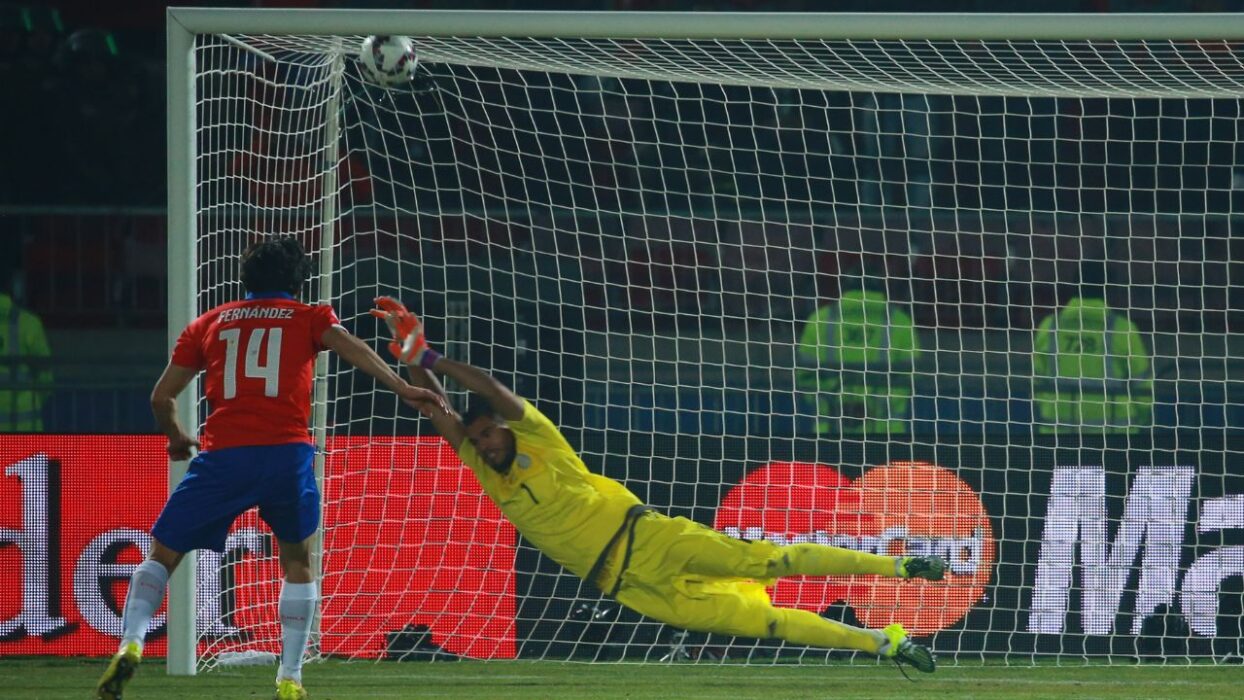
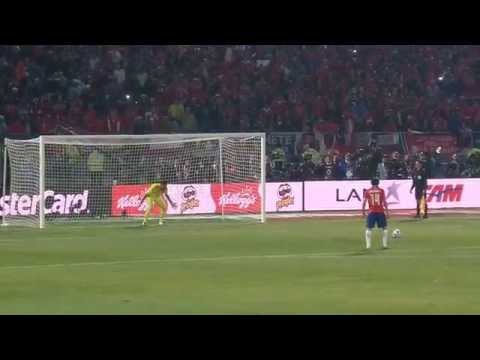
On July 4, 2015, in the final of the Copa América, Matías Fernández stepped up to take the first penalty for Chile against Argentina. The stakes couldn’t have been higher. His team had never won the Copa América. This was the moment.
Fernández had never been the biggest star on the Chilean team. Alexis Sánchez and Arturo Vidal were the household names. Eduardo Vargas had been the tournament’s leading scorer. Fernández, a midfielder who had moved to Europe with enormous promise years ago but never quite delivered on the biggest stages, was taking the first penalty in a World Cup-style final.
The analysis firm SB Nation later broke down what happened. First, Fernández had the advantage of going first. According to game theory, the team that shoots first in a penalty shootout has a 60.2 percent chance of winning. But if they miss, those odds collapse to 33.3 percent. Fernández was then either giving Chile the momentum of a perfect start or handing Argentina confidence before a single kick.
Then came the execution. SB Nation described his shot as “perfectly placed.” Fernández combined power with precision, sending the ball into the upper right corner of Sergio Romero’s goal. It was Hawking’s formula made real: upper corner, power, placement. The ball went exactly where the science said it should go.
But it also went somewhere Fernández didn’t expect it to.
The Moment of Truth
Years later, after the final and after Chile had won the tournament, Fernández reflected on what happened. “I told Arturo Vidal that I wanted to take the first one,” he said. “I had a lot of confidence. I closed my eyes and asked for it to be a goal.”
Then came the admission that contradicted everything about the formula. “The ball went in where I never imagined it would,” Fernández said. “Winning is nice, but doing it for La Roja has no words.”
He had executed the perfect penalty. But he hadn’t done it through precision. He had done it through faith. And somehow, in that moment of letting go of control, of surrendering to something larger than technique or tactics, he executed what scientists would later call perfection.